About this report
This report follows one line of argument: how a 1970s rate newsletter became a billion-dollar lead-generation business, why AI agents threaten that model, and what kind of platform could take its place.
- Scope. Parts 1 to 4 cover Bankrate, its owner Red Ventures, and the shift in search and advertising. Parts 5 to 7 look at AI agents, personal agents and the case for an exchange between consumer and bank agents. Parts 8 to 11 cover a product design for that exchange, the competitive field, two of the closest contenders, and how credit data reaches inside ChatGPT.
- Sourced vs. estimated. Figures with a link come from filings, company releases or reporting. Red Ventures and Bankrate are private, so many of their numbers are estimates. Anything marked estimate, speculative or this analysis's judgment is AgentContext's own reasoning, not company data.
- Not advice. This is strategic research, not investment, legal or financial advice. Public-company figures are as of the dates shown and will change.
Executive summary
Financial comparison sites were built to capture one moment, a consumer searching right before a purchase. AI is removing that moment, and the platform that replaces them will sit between two pieces of software rather than in front of a person.
- Bankrate is a lead-gen business on a data asset. A 1970s rate newsletter, it now earns referral fees from banks and insurers. Red Ventures bought it in 2017 for about $1.4B.
- Red Ventures is still profitable but past its peak. Revenue fell from about $2B (2021) to an estimated $1.6B or less; it sold CNET for a fifth of its cost, gave up control of its health business, and lost its largest customer in 2025.
- The balance sheet is stretched (estimate). Debt has held near $2.5B while EBITDA fell to roughly $350M, putting leverage near 7x and free cash flow near $100M a year. Equity value may be $1.5–3B against $11B+ in 2021.
- Search money is moving, not vanishing. Google earns more from search but sends 34% fewer clicks to publishers; ChatGPT ads hit a $1B run rate in under 200 days. Free clicks, Red Ventures' engine, are what is shrinking.
- AI uses Red Ventures' content without paying for it. Its sites supply about 40% of AI citations on credit cards, but referral fees are earned only on clicks.
- Personal agents remove the search moment entirely. Meta's Muse links bank accounts, works in the background and plans to charge businesses a fee per sale, which is Red Ventures' model run by the party that knows the customer.
- Agents will talk to agents, and someone has to sit between them. As with airline booking networks, direct connections don't scale; a neutral exchange routes requests, verifies both sides, standardizes firm offers, stages consent, keeps a best-execution record and settles fees.
- The Agent Exchange design starts with deposits and personal loans, charges a flat published fee per funded outcome, never ranks for pay, and wins supply first through existing networks and bank-side vendors.
- No one owns the layer yet. Experian and Intuit hold the credit data but are conflicted; agent platforms want the fee, not the regulated job; Engine by Gen is closest to neutral; LendingTree's CEO has described the thesis outright.
- The way in is narrow but real. A newcomer can rent supply and data, start with an anonymous app inside ChatGPT, win a niche, and publish to every agent surface, making neutrality with proof the product.
Part 1 — Bankrate
Bankrate, originally Bank Rate Monitor, is a personal-finance website that earns money by sending consumers to the banks, lenders, card issuers and insurers that pay it.
What the business does
Bankrate publishes interest rates and product data next to comparison tools and editorial content. Revenue comes from sponsored placements, referral fees when users apply for products, and advertising partnerships (Wikipedia).
Its original asset still exists. The weekly Bankrate Monitor (BRM) National Index tracks rates on deposits, loans, mortgages and cards; in May 2026 the St. Louis Fed's FRED database added 40 years of it. Bankrate says more than 100 million people use it each year. Recent job postings show where it is heading: its growth engine is described as a rate marketplace plus a loyalty loop, and being cited in AI-generated answers now ranks alongside traditional search optimization.
Who owns it
Red Ventures, a private company in Fort Mill, South Carolina, bought Bankrate in November 2017 for $14 a share in cash, about $1.4B in enterprise value and $1.24B in equity. Red Ventures was founded in 1999 by Ric Elias and Dan Feldstein; Silver Lake bought a minority stake for $250M in 2015. Bankrate's CEO since October 2025 is Matt Fellowes, an outside hire.
Revenue and financials
Bankrate has published no financials since going private in 2017.
| Point in time | Figure | Note |
|---|---|---|
| First nine months of 2000 | ~$9.1M online publishing revenue | Bankrate, Inc. (10-K) |
| 2008 | ~72M unique visitors | Before the Apax buyout |
| 2009 | $571M take-private by Apax | $28.50 a share (8-K) |
| 2011 | $300M re-IPO on the NYSE | Priced at $15; Apax kept about 70% (Apax) |
| 2016 | $434.2M revenue | Last reported; includes CreditCards.com, The Points Guy and Caring.com |
| Today | Not disclosed | Outside estimates of Red Ventures' own revenue range from $845M (IBISWorld) to $2B (2021), so any Bankrate figure is an estimate |
History
| Period | What happened |
|---|---|
| 1976 or 1982 | Journalist Robert K. Heady founds the Bank Rate Monitor newsletter in North Palm Beach, Florida; sources disagree on the year (founder page). Newspapers credit its rate tables nationwide. |
| 1993 | Heady sells to investors led by Peter C. Morse, who form Intelligent Life Corporation (Encyclopedia.com). |
| 1996 | Bankrate.com launches. |
| 1999–2000 | IPO on NASDAQ in May 1999 at $13 a share (original S-1, filed March 11, 1999, by Intelligent Life Corporation, formerly Bank Rate Monitor, Inc.); renames itself Bankrate, Inc. in 2000. |
| 2009–2012 | Apax takes it private, buys CreditCards.com and NetQuote, re-lists it, then adds The Points Guy. |
| 2014 | Buys Caring.com for $54M. |
| 2015 | Pays $15M to settle SEC accounting fraud charges over inflated 2012 results; the former CFO was later sentenced to 10 years. |
| 2017 | Acquired by Red Ventures. |
| 2023 | Pauses AI-written articles after errors at sister site CNET, restarts, and draws more criticism. Its June 2026 policy says it does not publish content written and edited only by AI. |
What matters for this report. Bankrate is a performance-marketing business sitting on a strong data asset. Revenue rises and falls with rate cycles and bank ad budgets, and it depends heavily on search traffic, which is why AI answers now matter so much to it.
Part 2 — Red Ventures
Red Ventures is still large and profitable, but since 2021 it has sold assets at a loss, given up control of its health business, re-levered, and lost its largest customer. AI search is the biggest threat to the whole model.
What the company is
Founded in 1999 by Ric Elias (still CEO) and Dan Feldstein, Red Ventures started as an outsourced sales and marketing firm, selling DIRECTV, before it owned any media. It now describes itself as a portfolio of U.S. businesses, a health joint venture and European investments. The founders control it; Silver Lake paid $250M for a minority stake in 2015 at a reported ~$1B valuation. By 2021 the New York Times reported about $2B in revenue and an $11B+ valuation. It has about 4,000 employees.
How it makes money
- Paid per customer sent to a seller (the core). Content built to rank in Google for high-intent searches, monetized with affiliate links (The Hustle). Personal finance pays best, with hundreds of dollars per approved credit card.
- Growth programs for big brands (the original business). Teams embedded inside home-services clients. It is concentrated in a few large clients, which is why losing one hurts.
- Owning the sale. MyMove runs the official USPS change-of-address flow under a 30-year exclusive contract; Sage Home Loans is its own mortgage lender, with $5.5B+ financed since 2020; RVO Health pairs its health audience with UnitedHealth's products.
Display advertising matters far less. CNET, which still lived on direct ad sales, never fit the model.
The portfolio
| Unit | Brands | How it is doing |
|---|---|---|
| Personal finance (core) | Bankrate, CreditCards.com, Sage Home Loans | New Bankrate CEO in October 2025; Sage offers Robinhood Gold members discounted mortgages. Exposed because AI Overviews answer most rate-comparison queries inline. |
| Travel | The Points Guy, Lonely Planet | TPG named ex-Stash CEO Liza Landsman CEO in June 2025; its traffic fell 21% in one March 2025 ranking. Lonely Planet is moving to an app and paid memberships. |
| Health (now controlled by UnitedHealth) | Healthline, Healthgrades via RVO Health | Put into a 2022 joint venture with Optum; Red Ventures used proceeds to repay $1.3B of debt. One analysis shows Healthline traffic halving, from 111M to 56M monthly visits. |
| Tech media (sold) | CNET | Bought for $500M in 2020; sold to Ziff Davis in August 2024 for a little over $100M. |
| UK comparison (partly owned) | RVU: Uswitch, Confused.com, Money.co.uk, Mojo, Tempcover | Formed from the $3B ZPG buy in 2018; co-owned with Silver Lake, GIC and PSP. |
| Moving | MyMove | USPS contract intact; paid $2.75M in 2023 to settle underpayment allegations. |
| Other | Allconnect, BestColleges |
The financials (estimates)
| Metric | Figure | Source |
|---|---|---|
| Revenue, 2021 | ~$2B | Company, via NYT |
| Revenue, 2024 | ~$1.6B | Flashes & Flames estimate |
| EBITDA | ~$400M in 2024, down from ~$600M | Flashes & Flames estimate |
| Leverage | 5.8x (2021) → 2.5–3x expected (2022) → 6.4x (2024), heading to 7x | S&P |
| S&P rating | Cut from BB- to B+ in May 2025, negative outlook | S&P |
| Moody's rating | Cut from B1 to B2, stable | Moody's |
Reading the numbers.
- Revenue is probably well below $1.6B now. That estimate still included CNET, and S&P says the company lost its largest (unnamed) customer in early 2025.
- Leverage roughly doubled between 2022 and 2024. At ~$400M of EBITDA, 6.4x implies about $2.5B of debt; if debt stayed near its post-2022 level, EBITDA would have had to fall to about $200M. The truth is likely in between, and the 2022 figures don't fully reconcile without the paid S&P report.
- Ratings path: B+ (2017), BB- (2019), lower before 2022, BB- again after the RVO paydown, B+ (2025). Both agencies are trending down.
Assessment
The personal-finance core is strong, and owning more of each sale (Sage, MyMove, RVO) is smart. But the model rests on ranking in Google for questions asked right before a purchase, and AI answers are replacing those clicks: Google search referrals to publishers fell 34% from December 2024 to December 2025.
Part 3 — A speculative balance sheet for Red Ventures
Debt has stayed around $2.5B for most of the period; what changed is profit, which peaked near $600M in 2021 and has since fallen to about $350M. Every figure here is an estimate built from rating actions and deal prices, not reported data.
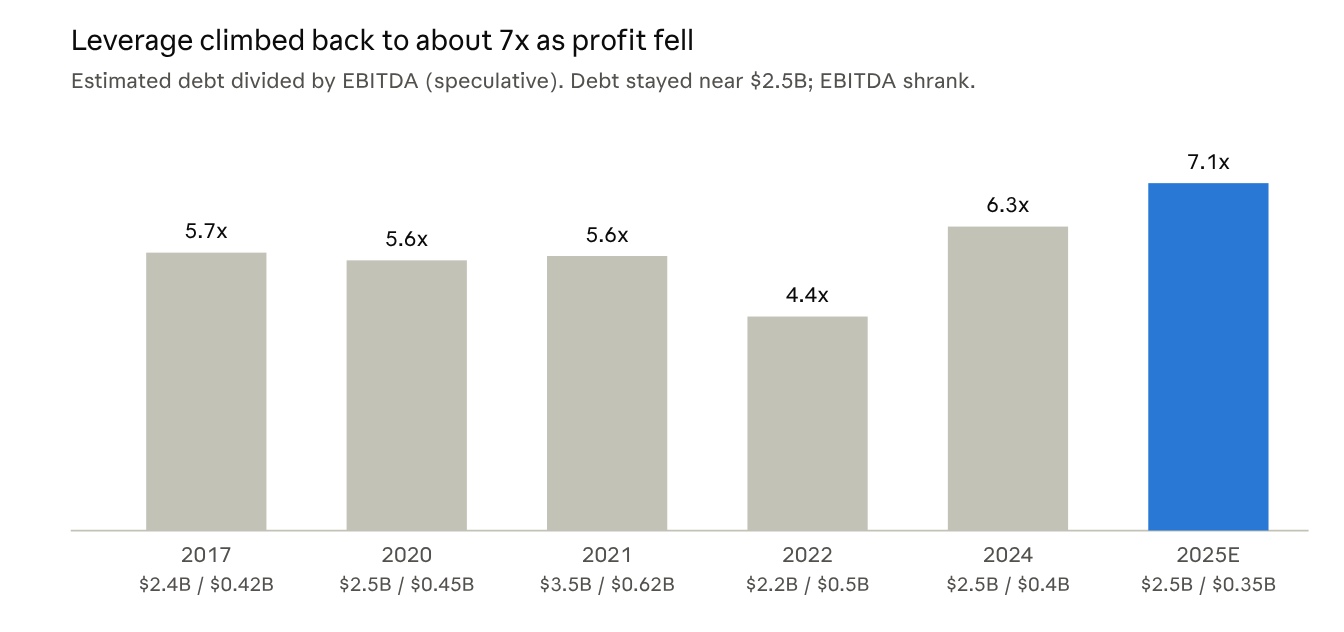
AgentContext estimates from S&P leverage figures and press reports, 2017–2025E.
Estimated balance sheet ($ billions)
| 2017 (after Bankrate) | 2020 (after CNET) | 2021 (peak) | 2022 (after RVO deal) | 2024 | 2025E | |
|---|---|---|---|---|---|---|
| Cash | 0.2 | 0.3 | 0.3 | 0.4 | 0.2 | 0.2 |
| Receivables and other current assets | 0.25 | 0.3 | 0.4 | 0.3 | 0.3 | 0.25 |
| Goodwill and intangibles | 2.1 | 3.4 | 4.2 | 3.0 | 2.5 | 2.4 |
| Stakes in partly owned businesses (RVU, RVO Health) | — | 0.3 | 0.3 | 1.2 | 1.1 | 1.0 |
| Other (campus, equipment, Sage mortgages awaiting sale) | 0.1 | 0.2 | 0.2 | 0.2 | 0.3 | 0.3 |
| Total assets | ~2.65 | ~4.5 | ~5.4 | ~5.1 | ~4.4 | ~4.15 |
| Debt | 2.4 | 2.5 | 3.5 | 2.2 | 2.5 | 2.5 |
| Other liabilities | 0.2 | 0.4 | 0.5 | 0.4 | 0.4 | 0.35 |
| Book equity (what is left over) | ~0.05 | ~1.6 | ~1.4 | ~2.5 | ~1.5 | ~1.3 |
How each year was built
- 2017. Bankrate was debt-funded. Nearly all assets are goodwill from Bankrate (~$1.4B) plus Imagitas ($310M in 2015), and $2.4B of debt roughly matches them, so book equity is near zero, typical of a borrowed buyout.
- 2020. CNET adds about $0.5B of intangibles (ViacomCBS booked $484M); Healthline and HigherEducation.com are guessed at $0.6–0.8B together. Debt follows the "almost $2.5B" press estimate.
- 2021. Healthgrades is acquired. Debt must rise to about $3.5B for S&P's 5.8x to work on ~$600M of EBITDA.
- 2022. About $1.2B of health goodwill moves into the RVO Health venture as one investment line; debt falls by $1.3B; a likely accounting gain lifts book equity.
- 2024. CNET leaves the books after a write-down of roughly $300–350M. Debt back near $2.5B fits 6.4x on ~$400M of EBITDA.
- 2025E. The lost customer pushes EBITDA to ~$350M; flat debt gives S&P's roughly 7x.
What changed
- Debt costs far more. At ~3% in 2021, $3.5B cost about $100M a year. At ~7–7.5% now, $2.5B costs about $180M. Profit covered interest about six times in 2021 and about twice now.
- Little cash is left to repay debt. $350M of EBITDA, less ~$180M interest, ~$40M capital spending and ~$30M tax, leaves ~$100M a year against $2.5B of debt.
- More value sits in businesses it doesn't control. About a quarter of assets are minority stakes in RVO Health and RVU, hard to turn into cash.
- The 2022 numbers don't add up. S&P expected 2.5–3x after the paydown; this estimate gives 4.4x. For S&P to be right, EBITDA without health would need to be $750–850M, or debt below $1.5B, which would mean meaningful new borrowing between 2022 and 2024. This is the biggest uncertainty.
What it might be worth (speculative)
At 8–10x EBITDA, the wholly owned operations are worth roughly $2.8–3.5B. Subtract ~$2.5B of debt and add perhaps $1–2B for the RVO and RVU stakes: owners' equity of something like $1.5–3B today, against $11B+ in 2021.
Part 4 — Search and advertising shifts
AI is moving advertising money around more than it is shrinking it. Search revenue is still growing and AI is creating new ad channels; what is shrinking is the free clicks that independent websites used to get, and those are what Red Ventures was built on.
What is changing
- Google earns more from search but sends fewer clicks out. In Q3 2026 Search revenue grew 12% to $63.35B while paid clicks rose only 8%, even as queries grew at a five-year high (analysis). AI Mode passed one billion monthly users and is filling with paid placements. Revenue from ads Google places on other sites was flat at $7.3B in Q2 (PPC Land).
- Fewer free clicks reach publishers. Google referrals to publishers fell 34% from December 2024 to December 2025 (Chartbeat); small publishers lost about 60%, large ones about 22%.
- ChatGPT became a real ad channel. Ads launched in January 2026 and passed a $1B annual run rate in under 200 days; 100,000+ advertisers had run campaigns by October. Prices fell from $60 to about $25 per thousand impressions, with clicks at $3–5. Measurement is weak, but AI-referred visitors buy at about 1.5 times the rate of other referrals.
- Checkout inside the chatbot failed. ChatGPT's Instant Checkout launched in September 2025 and was retired in March 2026; Walmart saw in-chat sales convert at a third of its own site's rate. Purchases still happen on the seller's site.
- Perplexity dropped ads and pays publishers. Its ad program ended in February 2026; Comet Plus gives 80% of revenue to publishers based on visits, citations and agent use.
- Content licensing is real but small. People Inc. gets at least $16M a year from OpenAI; Microsoft and reportedly Amazon are building pay-per-use content marketplaces. These add revenue but don't replace traffic.
What the closest competitors are doing
- NerdWallet. Organic search is a fraction of what it was after 3.5 years of decline; credit card revenue fell 24% in Q4 2025. Total 2025 revenue still grew 22% to $837M, driven by paid marketing, AI referrals and offering more products directly (MarketBeat).
- LendingTree. Its CEO argues AI changes discovery, not how financial products are bought, and puts chatbots at about 5% of search activity. It focuses on repeat and logged-in users (more in Part 10).
What it means for Red Ventures
Exposed: organic traffic at Bankrate, The Points Guy and the health sites; paid traffic squeezed by fewer clicks and rising cost per click; a B2B business whose clients are moving budget to AI ad formats; and credit cards, its richest category and NerdWallet's fastest decline.
Advantaged: proprietary rate data (the BRM index) that AI answers need; parts of the transaction it owns (Sage, MyMove, RVO); and distribution deals like Robinhood–Sage that don't depend on search.
The likely playbook (this analysis's judgment)
With roughly 7x leverage and about $100M of free cash flow a year:
- Get paid at the sale, not the click. Grow Sage; consider insurance agency or deposit products.
- Own the user relationship. Logins, rate alerts, apps and email, the "loyalty loop" in Bankrate's job postings.
- Be the source AI cites. Make rates and offers machine-readable, and license the data per use.
- Buy traffic on new channels. Bankrate's revenue per customer easily covers $3–5 ChatGPT clicks; the risk is banks buying those ads directly.
- Rebuild B2B around AI channels. Measurement is the AI platforms' weak spot and a performance marketer's opening.
- Keep pruning. Pure-content sites go; transaction-linked ones stay; selling the RVU or RVO stakes would cut debt fast.
- Be careful with AI content. After 2023, accuracy is the advantage AI systems reward when choosing what to cite.
The main risk sets up the rest of this report: if AI assistants match consumers directly with banks' own offers, the comparison-site middleman is cut out.
Part 5 — The risk of AI agents going straight to the bank
The danger isn't quite that AI sends people straight to banks. It's that AI uses Red Ventures' content to make the recommendation, and the referral fee that content used to earn goes to someone else.
Today AI relies on Red Ventures more than on banks
A study of 4,200 credit card prompts across ChatGPT, Claude, Perplexity, Gemini and Google AI Overviews (January–April 2026) found three publishers supplied more than 62% of cited sources:
| Publisher | Share of citations | Owner |
|---|---|---|
| The Points Guy | ~24% | Red Ventures |
| NerdWallet | ~22% | NerdWallet |
| Bankrate | ~16% | Red Ventures |
| All card issuers' own sites | under 6% | Issuers |
Red Ventures is the source for roughly 40% of AI answers about credit cards, and Bankrate supplies 17.8% of banking citations, second only to Wikipedia. But a citation doesn't pay. Issuer referral fees of $200–$900 per new card are earned only when the consumer clicks the publisher's link. If the answer quotes The Points Guy and the user goes straight to the issuer, Red Ventures did the persuading for nothing.
How the bypass happens, from most to least immediate
- The answer replaces the click (now). 59% of consumers have used AI to research a financial product, and 53% of those did what it suggested. In Q1 2026, a quarter of card applicants used ChatGPT the month before applying.
- Banks buy ads inside AI answers (starting). Google and OpenAI can sell the high-intent moment directly to issuers. OpenAI allows eligible regulated financial advertisers, cautiously.
- Personal agents that know your finances (the biggest long-term threat). ChatGPT now connects to bank accounts through Plaid across 12,000+ institutions, rolling out to Free users since October 2; Intuit's approval-odds integration is next. An agent that knows your spending and credit recommends better than any article. Red Ventures lacks that data; bureaus and Intuit have it, and Experian launched a card app in ChatGPT in August 2026.
- Agents completing the purchase (least threat for finance). Visa and Mastercard are building agent payments, but cards, mortgages and insurance require identity checks, credit pulls and underwriting.
Why AI companies may not want to replace the middleman
- Google tried and quit. Google Compare sold cards, insurance and mortgages on a per-customer basis in 2015–16 and shut after about a year. Platforms prefer selling ads to everyone over becoming the regulated middleman; OpenAI made the same choice in 2026.
- Platforms host partners. The Experian app shows the pattern, which leaves room for a Bankrate or Points Guy app. None had launched as of this research.
- Bank data isn't freely available. The CFPB open-banking rule is blocked by a court and being rewritten; large banks are charging for data access.
- A regulatory edge. AI answers recommend $400+ annual-fee cards about 5.7 times more often than fee-free ones, likely because affiliate rankings favor higher-paying cards. Scrutiny of AI financial advice would land on those publishers too.
Who ends up with the referral fee
| Scenario | Who gets the money | What it means for Red Ventures |
|---|---|---|
| AI platforms sell ads | Google and OpenAI | Content feeds answers but earns little |
| Platforms host specialist apps | Partners such as Experian | Workable if it ships apps fast with eligibility |
| Credit data wins | Bureaus, Intuit/Credit Karma | Squeezed: trusted content, no credit data |
| Banks go direct | Issuers keep the fee | Least likely soon; issuers are under 6% of citations |
What Red Ventures should do (this analysis's judgment)
- Ship apps inside ChatGPT and Gemini so the conversation, eligibility check and affiliate link stay in its experience.
- Get credit and eligibility data through a bureau partnership or its own soft-pull capability.
- Charge for its influence over AI answers through per-use licensing and bigger issuer partnerships.
- Protect editorial trust, the basis of its citation share.
- Shift toward products with a human-facing step: mortgages, insurance and deposits are far less exposed than card affiliate fees.
Part 6 — Personal agents like Muse
Once an agent works in the background, there is no search, no results page and no click left to capture. The agent fetches what it needs, so the questions become where it gets its information and who gets paid when it acts.
What Muse is
Meta launched Muse on September 8, 2026. It browses the web, fills out forms, sends email, books travel, negotiates, buys things, and keeps working after the user closes the app; it had 2.5M+ US downloads in about two weeks. Three features matter for finance:
- It works on its own, pinging the user only for decisions, with memory across conversations.
- It connects to bank accounts through Plaid, so users can set financial goals and act on them.
- It tracks goals over time, including financial ones. Early users report replacing tools like Empower within an hour.
From searching to monitoring
In the old model, a consumer searches "best savings rate," lands on Bankrate and clicks a bank; Red Ventures earns at that moment of intent. In the agent model, the consumer says once "keep my cash earning the best safe rate," and the agent watches the market from then on, moving idle cash and moving it back before bills are due.
That removes three things Red Ventures depends on: the search moment, the page view, and brand habit. The prize is large: US checking pays about 0.1% while alternatives advertise 3.3–5%. Rocket Money's agent already negotiates bills and automates savings; JPMorgan plans easier automatic sweeps in 2026.
Where would Muse get its information?
| What the agent needs | Who has it today |
|---|---|
| Everything about the user | The agent itself, through Plaid, email and memory |
| The market: rates, offers, terms | Thousands of bank sites, with aggregators like Bankrate between |
| Eligibility and price | Credit bureaus and lenders |
| The ability to act | Banks' systems, payment networks, emerging agent standards |
The second row decides Red Ventures' future. Muse could:
- Visit each bank's site. Slow, fragile and increasingly blocked; Amazon has already blocked Muse.
- Use an aggregator. But since September 15, 2026, Cloudflare blocks AI agents by default on ad-supported pages and is moving to pay-per-use, so agents may pay for each piece of rate data.
- Talk directly to banks' agents. The real threat. Meta is working with Shopify and Walmart on a Personal Agent Protocol so consumer agents can deal with business agents without navigating websites.
Meta wants Red Ventures' business model
Zuckerberg said Meta plans to charge businesses a fee when Muse helps complete a sale and to take "a percent of the value" it creates. That is lead generation, done by a party that knows the customer's real finances, acts continuously and owns the relationship.
What slows it down
- Banks can refuse. Cheap idle deposits are valuable, and outside agents moving them is a threat.
- Financial products need verification. Identity and credit checks stay with the lender, even as agent-identity standards arrive.
- Paid recommendations raise trust questions that will draw regulators.
- It's early. Muse connects to a limited set of services, and Meta hasn't disclosed fees.
Roles that could still pay, most to least defensible (this analysis's judgment)
- The neutral source of rates and terms both agents trust, sold by API or per use. Bankrate's 40 years of surveys are a real asset.
- The marketplace where agents and banks meet. An anonymous request goes out; banks' agents return firm offers. This is LendingTree's original idea rebuilt for agents (Part 7).
- A specialist agent Muse hands complex work to, such as mortgage refinancing, though Meta decides who gets the handoff.
- Owning the product, such as Sage as a lender.
The uncomfortable part: agents erode loyalty for everyone. If a bank knows the agent will move the money as soon as a better rate appears, each customer is worth less, and acquisition fees shrink. Comparison economics shift from occasional large fees to many small ones.
Part 7 — The platform between personal agents and bank agents
Banks will have agents, if only for efficiency, and websites will matter less. When a personal agent talks to a bank agent, LendingTree's original idea, "when banks compete, you win," fits better than it did on the web. The platform's job changes from winning the consumer's attention to being the trusted place where two pieces of software meet, compare offers and close.
Why a middle layer survives when banks have agents
- Direct connections don't scale. Every personal agent (Muse, ChatGPT, Gemini) would need its own link to thousands of banks, credit unions, lenders and insurers, each with its own rules and formats.
- Airlines already ran this experiment. Airlines built direct connections (NDC) to bypass booking networks like Sabre and Amadeus. American Airlines pushed hardest, reportedly at a cost of about $1.5B, and largely retreated by mid-2025; Turkish Airlines left Sabre and returned. The networks survived by aggregating the airlines' direct connections. Banking will likely follow: the biggest banks go direct, and the middle layer aggregates those connections at lower fees.
- Meta's protocol solves only the handshake. The Personal Agent Protocol, announced October 6 by Meta and Sierra with Walmart, Shopify, Stripe and mortgage lender Rocket, covers how an agent signs in to one business. It does not decide which banks to ask, make offers comparable, or prove the choice was fair, and it had no published spec at launch.
Six jobs the exchange does
| Function | What it means |
|---|---|
| Routing | Turn one need ("$40K, insured, flexible access") into requests to every eligible provider |
| Trust | Prove the consumer's agent is authorized and the bank's agent is really that licensed bank |
| Offer standard | Firm, comparable offers in a common format, not teaser rates; Bankrate's editorial work becomes a technical standard |
| Privacy | Reveal data in stages: anonymous, then a soft credit pull for a firm quote, then identity at commitment |
| Compliance | Record what was offered and why one was chosen, with disclosures, fair-lending checks and licensing |
| Settlement | Fees, attribution, and whether the bank honored the offer, feeding future routing |
Who pays, and whom does it serve?
LendingTree was paid by lenders, and comparison sites always carried that conflict. Agents sharpen it: if banks pay the exchange and Meta takes a cut of each sale, the consumer is represented by software paid by the seller and the platform. In this analysis's view, this resembles payment for order flow in stock trading, which regulators answered with a best-execution duty. Expect pressure toward the same standard. An exchange that can show "here were all the offers, and here is why this one was best" protects everyone, and that record may matter more than the routing. Fees probably end up mixed: banks pay per outcome, agent platforms pay for access and liability cover, and all fees are disclosed to the consumer's agent.
Who is positioned to build it
| Candidate | Brings | Missing |
|---|---|---|
| Engine (Gen Digital) | API marketplace, 1,300+ partners, approval probability and rate tables (APIs.io) | A consumer brand, which agents care little about |
| LendingTree | Lender and insurer network, the original idea | Management has played down AI disruption |
| Red Ventures | The rate data AI already relies on, plus Sage | Lender-paid model; heavy debt |
| Experian, Intuit/Credit Karma | Credit data for firm offers | Run their own marketplaces, so neutrality is in question |
| Plaid, Visa, Mastercard | Account connections and agent identity | Probably don't want the regulated matching role |
| Meta, OpenAI, Google | Own the consumer's agent | Conflicted as representative and fee collector |
| Bank-side vendors | Eltropy is building a governed agent marketplace for 750+ credit unions and community banks | Could become the hub for small institutions |
Small banks and credit unions can't each build agents and connect to every assistant. Like large airlines, big banks go direct; the long tail is where an exchange is most needed.
Where it starts, and what's hard
It starts where price is most of the decision: deposits, personal loans and auto insurance. Mortgages and cards come later because of heavier regulation and hard-to-standardize rewards.
- Chicken and egg. The winner aggregates existing supply first, as booking networks did.
- Competing protocols. Meta's, Google's, OpenAI's and Visa's are all forming; translating between them is valuable.
- Regulation. State lead-gen and broker licenses, mortgage referral rules and fair-lending review: a burden, then a moat.
- Bank resistance. Agents threaten cheap deposits, which favors an exchange whose rules banks trust over a consumer platform.
Part 8 — Agent Exchange: product design
The Agent Exchange is a neutral marketplace where a consumer's personal agent posts a financial need once and receives firm, comparable offers from every eligible bank, credit union, lender and insurer's agent. Whoever owns that layer earns a fee on every agent-driven account opening, loan and policy, and becomes the record regulators rely on. Design principle: it works for the consumer's outcome, discloses its rules, fees and conflicts, and leaves an audit trail for every match.
Participants
| Participant | Needs | The exchange gives them |
|---|---|---|
| Personal agent platforms (Muse, ChatGPT, Gemini, Rowan) | Every relevant offer, in one format, plus proof they acted for the user | One integration to thousands of institutions; a best-execution record that limits liability |
| Consumers | Best outcome without exposing their finances to every bank | Identity revealed only at commitment; ranked results with reasons; recourse |
| Large banks and issuers | Agent demand without dozens of bespoke integrations | One endpoint; consented requests; pricing per funded outcome |
| Small banks and credit unions | A way to compete they cannot build | A hosted offer agent; equal footing on rate |
| Lenders and insurers | Firm quotes to high-intent requests | Soft-pull eligibility; prefilled applications |
| Regulators | Evidence matching is fair and disclosed | A complete audit trail |
Six functions: MVP and later
| Function | MVP | Later |
|---|---|---|
| Routing | Fan out to all listed institutions for the product and state; collect within a set window (about 60 seconds for deposits) | Routing by likely approval; standing requests that re-run when rates change |
| Trust | OAuth-style consent tokens compatible with the Personal Agent Protocol; institutions checked against FDIC/NCUA and state license data | Reputation scores; fraud and synthetic-identity screening |
| Offer standard | Required schema per product: rate, fees, minimums, term, conditions, expiry, firm or indicative | Rewards modeling for cards; total cost of ownership |
| Privacy | Stage 1 anonymous; stage 2 consented soft pull; stage 3 identity at commitment | One reusable verified identity across institutions |
| Compliance | Immutable log of requests, offers, rankings and choices; Truth in Savings and Truth in Lending disclosures attached | Fair-lending testing; regulator dashboards |
| Settlement | Per-outcome billing; confirmation the account opened or loan funded at quoted terms | Revenue sharing with agent platforms; 90-day honor tracking |
A deposit request, end to end
The agent posts "$40,000, FDIC-insured, withdraw anytime, no monthly fee" with a stage-1 consent token. The exchange checks the agent's authorization, sends the request to every listed bank and credit union, and returns all offers ranked by APY after fees. The user approves the top choice; only then does that bank receive identity, open the account and confirm funding. The exchange logs the match and bills the bank. For a personal loan, a consented soft pull runs between routing and offers so lenders return firm rates; declines carry a reason code into the match record.
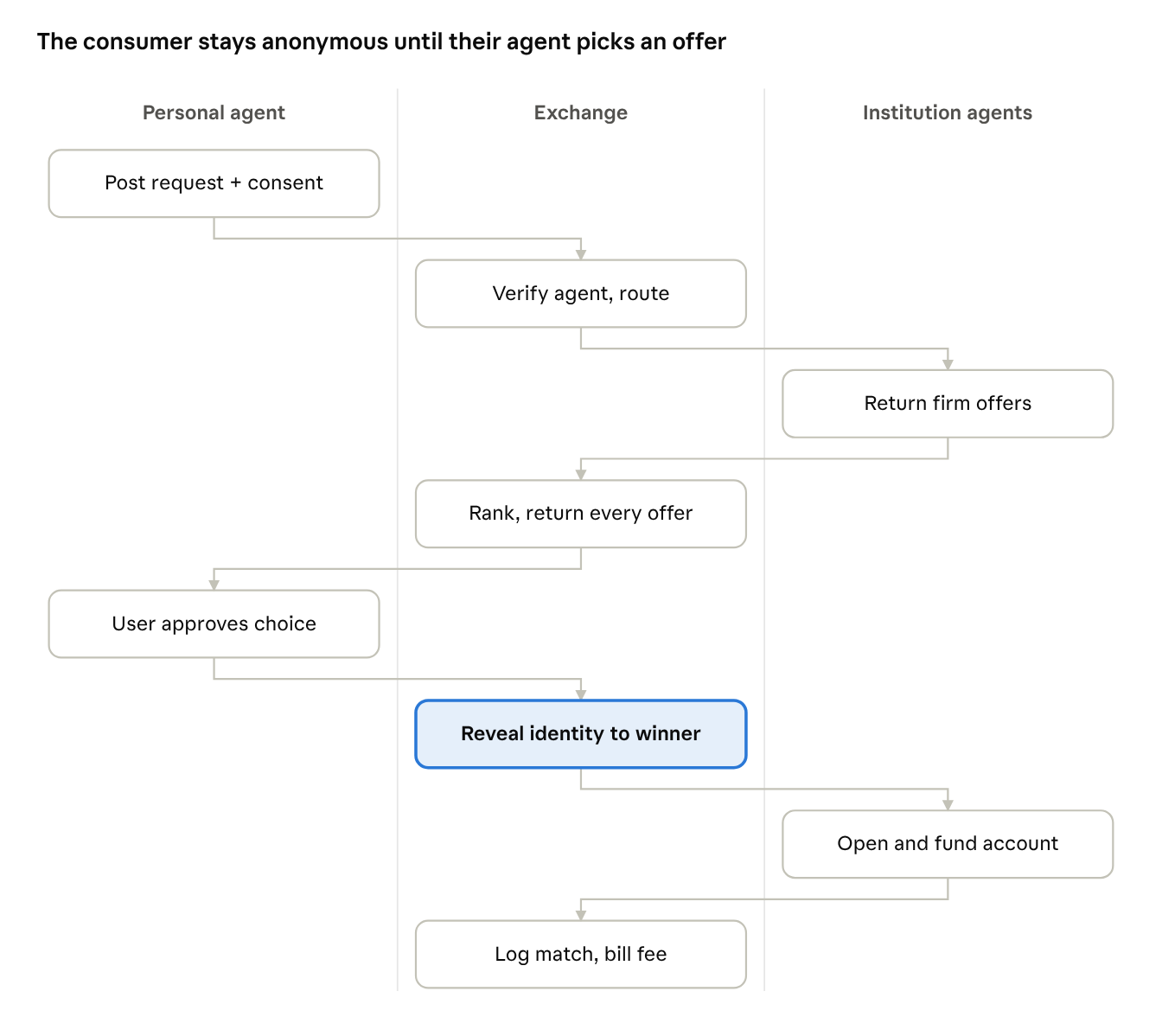
A deposit request through the exchange: 8 steps, 3 parties. The consumer stays anonymous until their agent picks an offer.
Data model and interfaces
Four objects: the request (product, amount, state, constraints, disclosure stage, consent token), the consent token (pseudonymous consumer id, agent id, scopes, expiry, revocation), the offer (institution, rate, fees, terms, firm or indicative, disclosures) and the match record (all offers, ranking inputs and output, choice, fees, outcome).
- Agent side: an MCP server and REST API (request, offers, select, status), accepting Personal Agent Protocol sign-in and mapping to Google's and OpenAI's commerce protocols.
- Institution side: a webhook or API returning offers in the schema, plus a hosted offer agent for institutions that only upload a rate sheet.
- Identity and data: agent verification through Visa's Trusted Agent Protocol and Cloudflare's Web Bot Auth where available; account data via Plaid, MX or Finicity with consent; credit via bureau soft pull. Publish the schema early to shape the standard.
Neutrality rules
- Every eligible offer is returned to the agent.
- Ranking uses consumer outcome only (net yield or net cost after the consumer's constraints); fees to the exchange are never an input.
- No paid placement inside results; any sponsored offers sit in a separate, labeled list.
- Every institution pays the same published fee per outcome within a product.
- Each response discloses what the exchange earns and any revenue shared with the agent platform.
- Agents may re-rank by their user's priorities, and the record notes it.
Business model
Institutions pay a published fee per funded account, funded loan or bound policy, the cost-per-acquisition model they already budget for, without rank-for-pay. Later lines: a firm-quote fee if quotes outrun outcomes, a hosted offer agent subscription for small institutions, benchmark data and audit exports, and a disclosed revenue share to agent platforms only if needed for distribution. Today's comparison sites earn $200–$900 per new card; the exchange should price below institutions' current acquisition cost, because agent-driven customers are less loyal.
Go to market
- First products: high-yield savings and CDs (no credit pull, rate is the product), then personal loans (Engine already proves firm-offer APIs), then auto insurance once licensed.
- Supply first: load published deposit rates as labeled indicative offers; sign 20–30 online banks and lenders for firm offers; partner with bank-side vendors such as Eltropy to list their clients.
- Demand: ship the MCP server so any agent builder integrates in a day; court independent finance agents first; then approach Meta, OpenAI and Google with coverage numbers and the best-execution record.
Regulation and risks
| Area | Design response |
|---|---|
| State lending, broker and lead-gen licenses | Launch with deposits; add loans state by state |
| Mortgage referral rules (RESPA) | Exclude mortgages from the MVP |
| Insurance producer licensing | Partner with a licensed agency first |
| Credit reports (FCRA) | Soft pull only at stage 2, under explicit consent |
| Fair lending (ECOA) | Exclude protected attributes; test for disparate impact |
| Unfair or deceptive practices (UDAAP) | Rank only on disclosed criteria; return every eligible offer |
| Open banking (1033 enjoined) | Use consumer-permissioned aggregators |
Failure modes: big platforms build their own (be their neutral supplier, priced below build cost); large banks refuse (start with online banks hungry for acquisition); offers not honored (firm flags, outcome tracking, delisting); agent errors (consent scopes checked on every call).
Metrics: institutions returning firm offers by product; share of requests that fund; consumer gain versus their current product; agent platform concentration; offers honored at 90 days; fee versus institutions' current acquisition cost.
Roadmap
Each phase opens only when the gate before it is met.
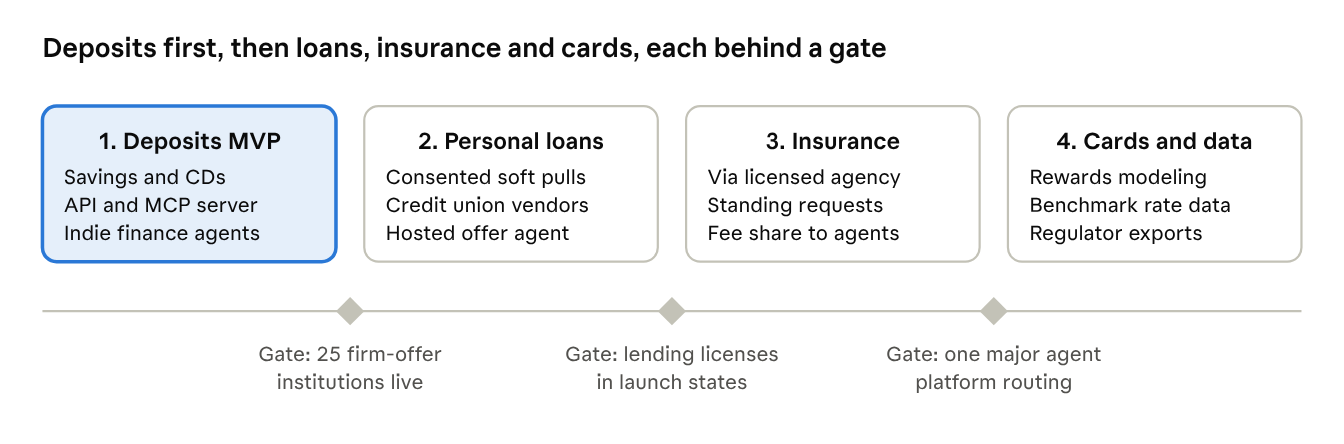
Roadmap: 4 phases, 3 gates, not to scale. Gate targets are proposals to test.
Part 9 — Competitor map
No one owns the neutral exchange layer yet. Experian and Intuit are closest because they hold the credit data that turns estimates into firm offers and already run marketplaces inside ChatGPT, but both earn from the offers they show. The players with consumer reach are all paid by sellers; the neutral players are infrastructure that doesn't match offers. The biggest structural risk is the chatbot itself becoming the aggregator by calling several marketplace apps and comparing results; the exchange's defense is what a chatbot can't supply: firm offers, staged consent and an auditable record of fair selection.
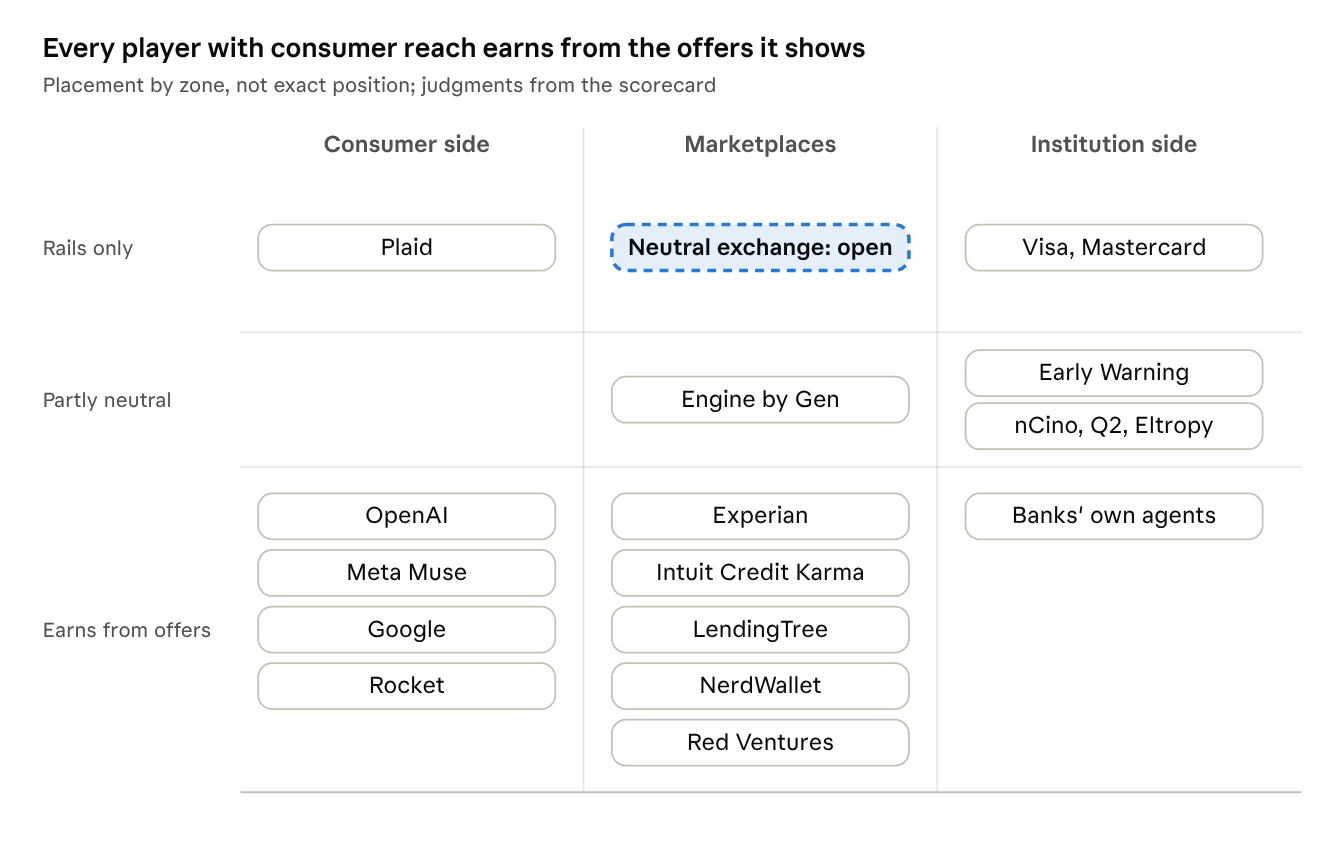
Every player with consumer reach earns from the offers it shows. Placement by zone, not exact position.
Scorecard (this analysis's judgment)
| Player | Institution supply | Consumer and credit data | Agent presence | Neutrality | Threat |
|---|---|---|---|---|---|
| Experian | High | High | High: Agent Trust; loan, insurance and card apps in ChatGPT | Low | Very high |
| Intuit Credit Karma | High | High | High: approval odds in ChatGPT | Low | Very high |
| OpenAI (ChatGPT) | Low (via apps) | High (Plaid-linked) | Very high | Low: ads, paid apps | High |
| Meta (Muse) | Low | High (Plaid-linked) | High | Low: fees from businesses | High |
| Engine by Gen | High (600+ products) | Medium | High: Savvy for agents; Microsoft Copilot feeds | Medium | High |
| Raisin | High (~400 banks and partners) | Low | Low: no agent product found | Medium: banks pay to be featured | High (deposits) |
| LendingTree | High (430+ partners) | Medium | Medium: mortgage research app | Low | Medium |
| Plaid | None | High (accounts) | High | High: rails, not offers | Medium (partner or entrant) |
| Rocket Companies | Self (lender) | High (own clients) | High: Rowan, mortgage agent | Low | Medium |
| Early Warning (Zelle owner) | Very high (2,500+ institutions) | High (identity, fraud) | Low | Medium: bank-owned | Medium |
| NerdWallet | Medium | Low | Low | Low | Low-medium |
| Red Ventures | Medium | Low | Low: no ChatGPT app found | Low | Low-medium |
| Visa, Mastercard | None | Medium | High: agent payments | High | Low (partner) |
| nCino, Q2, Eltropy | High (their clients) | Low | Medium | Medium | Low (partner) |
Financial marketplaces
- Experian has the most complete position: Agent Trust (April 30, 2026), a "know your agent" framework binding a verified person, device and agent, built with Visa, Cloudflare and Skyfire; plus ChatGPT apps for loans, insurance (35+ carriers) and cards. It is both referee and seller.
- Intuit Credit Karma has a multi-year deal worth more than $100M with OpenAI and a Debt Assistant agent pairing a consolidation plan with offers and approval odds.
- Engine by Gen is the closest thing to a neutral exchange today: 600+ products, about 400M annualized queries, APIs that return approval probability and rate tables, and now agent-facing channels in Savvy and Microsoft Copilot (Part 10).
- Raisin already runs the deposit marketplace a deposits-first exchange would meet, in the US and Europe: with Deposit Solutions it works with about 400 banks and financial services providers in 30+ countries, and partner banks pay a fee to be featured. No agent product was found.
- LendingTree has a research-only ChatGPT mortgage app and insurance at two-thirds of revenue (Part 10).
- NerdWallet buys traffic and adds products; no agent product found.
- Red Ventures supplies about 40% of AI card citations but has no agent API; its best exchange asset is Bankrate's benchmark rate data.
Agent platforms
They own the consumer and want a cut, but so far they host marketplaces rather than run one, making them the exchange's key customers and largest long-run risk. OpenAI earns from ads and hosts Intuit, Experian and LendingTree apps; Meta plans per-sale fees and co-authored the Personal Agent Protocol; Google sells AI Mode ads, runs the Universal Commerce Protocol and already exited comparison once; Perplexity has Plaid-linked finance and no ads, making it a natural early partner; Rocket is vertically integrated, a supplier more than a buyer.
Rails and identity
Plaid is the default account connection for ChatGPT and Muse and partnered with Sierra in August 2026; partner first, watch closely. Visa and Mastercard run agent payment programs. Cloudflare sets bot defaults and offers Web Bot Auth and Pay Per Use. MX is building a bank growth agent. FDX is the data API standard to support while the CFPB rewrites 1033.
Institution-side platforms
| Player | Reach | Agent activity | Role |
|---|---|---|---|
| nCino | 2,700+ banks, credit unions, mortgage lenders | "The platform for agentic banking" | Connect clients' lending offers in one integration |
| Q2 | Digital banking for banks and credit unions | Q2 Assistant (June 2026); pricing agents in development | Deposit offers and account opening |
| Eltropy | 750+ credit unions and community banks | Governed agent marketplace (July 2026) | Host the exchange's offer agent |
| Sierra | Enterprise agents (Rocket and others) | Co-author of the Personal Agent Protocol | Implement the offer schema |
| Early Warning | Owned by 7 large banks; runs Zelle and Paze | Certos identity and fraud unit | Possible bank-owned rival, or the trust partner banks accept |
Scenarios
| Scenario | Who wins | Room for a neutral exchange |
|---|---|---|
| Data owner wins | Experian or Intuit | Narrow: neutrality and deposits |
| Platform absorbs it | OpenAI or Meta | Supplier behind the platform's feature |
| Banks build their own | Early Warning or a consortium | Serve online banks, lenders and insurers outside it |
| Neutral exchange emerges | Engine, LendingTree or a new entrant | Full opportunity |
For a new entrant
Enter through deposits and small institutions, partner with infrastructure, and make neutrality the product. White space: neutrality with proof, firm comparable offers, deposits (where credit data matters least), and the long tail of small banks. Partners: Plaid, institution-side vendors, Perplexity and independent agents, a bureau willing to sell soft-pull eligibility, and a rate-data owner like Bankrate. Threats: chatbots comparing apps well enough; Experian or Intuit adding a neutral-looking layer; a bank consortium admitting only members; Gen extending Engine's agent access, begun with Savvy and Microsoft Copilot, to loans and cards; Raisin opening its deposit marketplace to agents.
Part 10 — Engine by Gen and LendingTree
Engine is further along on the agent exchange; LendingTree has said the thesis most plainly. Each has half of what the exchange needs.
Side by side
| Engine by Gen | LendingTree | |
|---|---|---|
| Owner | Gen Digital (Norton, Avast, LifeLock), via the ~$1B MoneyLion purchase in April 2025 | Public (NASDAQ: TREE), market value under $500M at recent prices |
| Model | Business-to-business: apps and sites embed its offers; partners pay per click, transaction or revenue share | Consumer marketplace; lenders and insurers pay per consumer request |
| Latest revenue | Not broken out; MoneyLion's Enterprise business was $177.5M in 2024 | $343.6M in Q3 2026, up 12% |
| Supply | 1,300+ enterprise partners; 500+ distribution channels | 430+ lenders and insurers |
| Agent product | Savvy, an insurance site built for AI agents (September 30, 2026) | ChatGPT mortgage rate research app (Q2 2026) |
| Neutrality | Medium, but shifting toward its own demand | Low: lender-paid, consumer brand |
| Financial capacity | High: Gen year-to-date free cash flow $753M | Limited: deleveraging, first buyback since 2022 |
Engine by Gen
Even Financial was founded in 2014, bought by MoneyLion for up to $440M in 2022, rebranded Engine in 2023, and came to Gen Digital when it closed the ~$1B MoneyLion deal on April 17, 2025. Partners pay per click, completed transaction or revenue share, plus platform fees (10-K). Engine sits in Gen's Trust-Based Solutions segment, which earned $511M in Q2 FY27, up 26%, at about a 30% margin; Engine added 18 partners and more than doubled matched inquiries.
Agent readiness is its edge. Savvy for agents (October 2026) offers one page of questions, anonymous estimates and quotes without calls from multiple insurers, naming Muse as an expected agent, as a first step toward connecting the whole marketplace to agents. Since April 2026 Engine also powers financial recommendations in Microsoft Copilot, MSN and Bing feeds. Gen's Agent Trust Hub (February 2026), VPN for Agents and AI Data Checker position Gen as the trust layer for agents; skills scanned through the hub have been installed 100M+ times. Its APIs already return approval odds and rate tables.
Risks. Agentic revenue won't be material this fiscal year. Gen is shifting Engine toward first-party demand from its own customers: better margins, less neutrality. Marketplace growth caps segment margin near 30% against roughly 61% in core security.
LendingTree
LendingTree is now mainly an auto-insurance lead marketplace with lending attached, growing double digits for ten straight quarters while paying down debt.
| Segment, Q3 2026 | Revenue | Growth | Segment profit |
|---|---|---|---|
| Insurance | $234.9M | +15% | $54.2M |
| Consumer | $67.2M | +2% | $29.6M (−16%) |
| Home | $41.5M | +9% | $12.4M |
| Total | $343.6M | +12% |
- 2025: about $1.12B revenue; net leverage fell from 3.5x to 2.4x (Q4 release).
- 2026: guidance midpoint implies about 17% revenue growth. Q3 had a $98.8M non-cash goodwill write-down (a $72.4M GAAP loss), adjusted EBITDA of $39.6M, $60M of debt repaid and a first buyback since 2022 (8-K). Insurance is about 68% of revenue.
- AI moves: a ChatGPT app that gives no lender-specific quotes; AI voice adding $10M+ of quarterly revenue; LLM traffic converting four to five times better than legacy search.
- The vision: on the Q3 2026 call, CEO Scott Peyree asked why an agent like Muse would query 20 loan sites when LendingTree's specialty agent could return the same quotes in one exchange. That is this report's thesis, stated by an incumbent.
- The gap: a May 2026 scan rated its site 43/100 for agent readiness, with no APIs or MCP endpoints exposed.
Fit as an agent exchange (this analysis's judgment)
| Function | Engine by Gen | LendingTree |
|---|---|---|
| Routing | Strong | Strong |
| Trust and agent identity | Strong | Weak |
| Firm, comparable offers | Medium | Medium |
| Privacy, staged data | Strong | Weak |
| Compliance and best execution | Medium | Medium |
| Settlement and fees | Strong | Strong |
Scenarios (speculative): (1) Gen buys LendingTree, joining Engine's trust layer to LendingTree's supply, the strongest exchange candidate; (2) the two partner; (3) each goes alone, with Engine leading in insurance; (4) Experian or Intuit takes lending while Engine and LendingTree hold insurance. Neither company has signaled a combination.
Part 11 — Credit data inside ChatGPT
Building a ChatGPT app is the easy part: an MCP server, an optional widget and OAuth account linking, a few weeks of work. The moat is the data, the lender supply and the legal permissions behind it.
How Experian got there
Experian went from no personal data to monetized offers in under six months.
- Anonymous averages (March 13, 2026). A UK app that compares typical scores by postcode and age group from aggregated, anonymised data: no consent flow, nothing to leak, and a sign-up funnel.
- Logged-in personal score (August 20, 2026). Users who link their account see their own score in ChatGPT; the full report stays on Experian's site, so Experian keeps the relationship.
- Card offers (August 27, 2026). A US credit cards app with Credit One Bank as a partner, giving lenders an offer comparison where financial advertisers have little paid placement.
It is the staged consent of the Agent Exchange design in practice: anonymous first, identity only when needed.
How Intuit got there
Intuit bought position and brought unique data: a multi-year contract worth more than $100M (November 2025) for TurboTax, Credit Karma, QuickBooks and Mailchimp inside ChatGPT. Its apps match cards, loans and mortgages to spending and approval likelihood, drawing on Credit Karma's profiles and approval history, and it starts from roughly 100 million customers.
The four layers
| Layer | What it is | Who has it | Difficulty to copy |
|---|---|---|---|
| 1. The app | MCP server, widget, OAuth | Anyone | Low |
| 2. Data about the user | Credit file, or bank and card cash flow | Experian, Credit Karma | High: the main moat |
| 3. Offer supply | Lender agreements and approval models | Credit Karma, Engine, LendingTree | High |
| 4. Permissions | FCRA permissible purpose, state broker licenses, lender trust | Established players | Medium: slow but attainable |
Building it from scratch
- Rent supply from an existing offer network such as Engine's APIs, starting as a reseller, as Even Financial once did.
- Rent credit data from licensed bureau resellers, with consent and FCRA obligations.
- Use cash flow instead of scores through aggregators like Plaid, knowing a personal agent may already hold this data; don't build on the 1033 rule's uncertain final shape.
- Start anonymous, like Experian: a "what would someone like you qualify for" app needs no personal data and no lender contracts beyond affiliate links.
- Pick a niche the giants underserve: small business, thin-file borrowers, home equity, or one state's insurance market.
The platform caveat
OpenAI decides which app appears when someone asks a money question, and part of Intuit's payment buys that position. A company that exists only as a ChatGPT app rents distribution from a landlord that also sells ads. The durable version is built once and published wherever agents look: ChatGPT apps, a standalone MCP server, Google's Universal Commerce Protocol and the Personal Agent Protocol. The ChatGPT app is the wedge; the Agent Exchange is the company.
What to watch
These signals over the next 12 months would show which way the agent layer is settling.
- Red Ventures: any AI licensing or agent data deal for Bankrate; Sage growing beyond Robinhood; a sale of the RVU or RVO Health stakes; NerdWallet's quarterly card revenue as an early warning.
- Credit data in chatbots: Intuit's approval odds going live in ChatGPT; Experian adding issuers; Google adding card-comparison ads to AI Mode.
- Personal agents: whether banks join the Personal Agent Protocol or build their own; Meta announcing finance-specific fees; any large bank blocking or partnering with Muse.
- Engine by Gen: Savvy extending past insurance into loans or cards; Gen disclosing agent-originated volume.
- LendingTree: a public API, MCP server or agent-identity partnership behind its "specialty agent"; debt below $200M.
- Rules: the rewritten CFPB 1033 rule, and any regulator addressing how finance agents choose and disclose offers.
- Raisin: opening its US or European deposit marketplace to AI agents, which would bring signed deposit supply straight into agent channels.
Selected sources
Bankrate and Red Ventures
- Bankrate 8-K on the Red Ventures acquisition (2017)
- SEC press release 2015-180
- NYT via bdnews24 on Red Ventures
- S&P: Red Ventures downgraded to B+ (2025)
- Moody's: Red Ventures downgraded to B2
- Flashes & Flames: What next for Red Ventures?
- Axios: CNET sold to Ziff Davis
- Original S-1 registration statement (SEC, March 11, 1999)
Search, ads and agents
- Chartbeat: pageviews and AI
- OpenAI: ChatGPT ads
- 5W Credit Cards AI Visibility Index
- OpenAI: personal finance in ChatGPT
- Plaid powers Meta's Muse
- Fortune: Zuckerberg on Muse monetization
- McKinsey: The end of inertia
- Constellation: Personal Agent Protocol
- Open Banking Tracker: Section 1033
Exchange contenders
- Experian Agent Trust
- TechCrunch: Intuit and OpenAI
- Engine by Gen opens Savvy to AI agents
- LendingTree Q3 2026 8-K
- LendingTree Q3 2026 call
- Eltropy agent marketplace
- Gen brings Engine to Microsoft Copilot and Discover feeds
- Raisin and Deposit Solutions combine
- How Raisin's deposit marketplace is paid
Each part links its own sources inline.